

Project Insights Report
Real Estate Development Incubator: A Model for Equitable Participation
 Partners
 Locations
Ontario
 Investment
$2,970,296
 Published
July 2025
 Contributors
Val Duarte

 Executive Summary
Canada is facing a deepening housing crisis while its real estate development industry remains starkly unrepresentative of the population it serves. Despite Black, Indigenous, and other people of colour (BIPOC) comprising over half of Toronto’s population, only 14% of leadership positions in real estate are held by racialized individuals. At the same time, BIPOC communities are those most affected by housing unaffordability.
Monumental Projects Inc. set out to address both sides of this gap. Using findings from a 2020 national research phase that mapped the barriers and experiences of BIPOC professionals in real estate, they designed and launched a pilot for FutureBUILDS – Canada’s first real estate development incubator for BIPOC professionals – in partnership with the University of Toronto’s Infrastructure Institute.
Over four phases of FSC-funded work spanning 2020 to 2025, the program has grown into a multi-stream initiative that has engaged over 1,300 individuals; supported two incubator cohorts totalling 56 mid-career BIPOC entrepreneurs; and, in 2025, launched the FutureBUILDS NEXT Fellowship for Black professionals aged 18–32 pursuing careers in non-profit and Black-led housing.
Across all phases, the program has shown strong outcomes. In total, 83% of first-cohort participants made substantial changes to their housing development projects, and 35% were in the City of Toronto approval process by program completion. In the second incubator cohort, self-assessed understanding of feasibility and design nearly tripled. The FutureBUILDS NEXT Fellowship for early-career Black professionals fostered leadership development and deep understanding of non-profit housing systems. The Halifax learning trip emerged as a particularly transformative experience. Two public conferences extended the program’s reach, with 98% of XP Conference attendees reporting new professional connections. While community and peer connection are among the program’s most powerful and enduring outcomes, participants across all cohorts report facing significant obstacles in securing the financing needed to move their projects forward.
The FutureBUILDS cohort-based training, combined with social capital building, presents a scalable model for multifaceted skills training tailored to BIPOC individuals across different sectors, with lessons that extend well beyond real estate development.
Key Insights
 Among the first group of participants, 83% made substantial changes to their projects, and 35% reached the City of Toronto approval process by program completion.
 The FutureBUILDS NEXT Fellowship for early-career Black professionals achieved the highest learning gains, with participants reporting an increase in confidence in housing development planning from 1.35 to 3.75 on a 5-point scale.
 Access to capital remained a persistent barrier before and after program participation, underscoring the need for dedicated funding mechanisms for BIPOC developers beyond skills training.
 The Issue
The real estate industry is vital to the Canadian economy as residential construction constitutes 10% of Canada’s gross domestic product (GDP). At the same time, Canada is grappling with a housing crisis with challenges including threats of economic uncertainties, rising costs of living and overcrowding. The Canada Mortgage and Housing Corporation (CMHC) estimates that an additional 3.5 million housing units are needed by 2030 to close housing gaps. Yet the industry working to close that gap remains deeply unrepresentative of the racialized communities bearing the brunt of the crisis.
With over 300,000 employed Canadians, the real estate industry lacks representation of racialized professionals, especially at leadership levels. In 2016, while over half (51.4%) of Toronto’s Census Metropolitan Area was made up of racialized people, only 14% of owners or executive positions in real estate were held by racialized individuals. One survey found that only 16% of industry professionals considered their workplaces to be “very diverse.” The barriers go beyond the numbers. Interviews with BIPOC professionals, conducted as part of Monumental’s initial research, uncovered unjust recruitment practices, challenging workplace cultures, inadequate access to mentorship, and persistent biases in promotion decisions. Therefore, it is imperative to engage BIPOC professionals at the forefront of solving this crisis, to deepen understanding of its disproportionate impacts, and dismantle systemic barriers to accessing real estate opportunities.
Data on BIPOC representation exists. However, it lacks the granularity needed to understand the lived experiences of racialized professionals, the specific barriers they face, the supports they need, and the pathways that could allow them to enter and lead the industry from within. Recognizing this gap, Monumental Projects Inc. saw the need for both a stronger evidence base and innovative programming that could empower BIPOC individuals to contribute meaningfully to inclusive city-building.
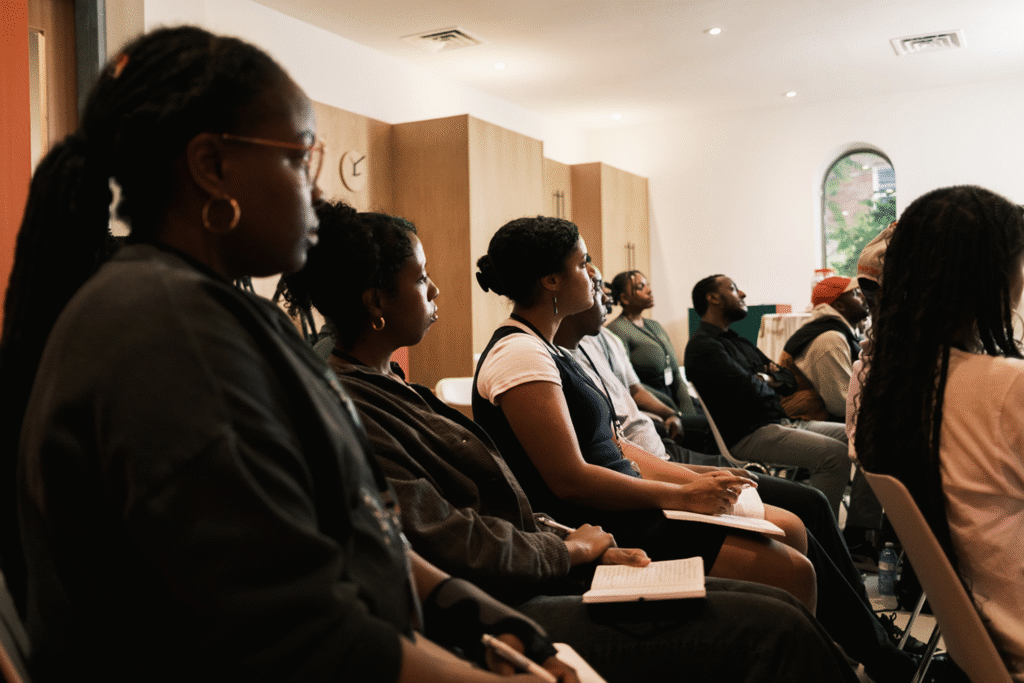
 What We Investigated
Phase 1 — Mapping BIPOC experiences in the real estate industry
In 2020, Monumental Projects Inc. began building the evidence base for an effective program. Through a literature review, key informant interviews, a co-design roundtable, and an online survey, this first phase sought to understand:
- What is the state of representation of racialized individuals in the real estate development industry?
- What are the common barriers and opportunities that racialized individuals face when attempting to build a successful career in the industry?
- What skills and support do racialized professionals need to succeed?
Phase 2 — The FutureBUILDS Pilot Incubator
Based on these findings, Monumental partnered with the University of Toronto’s Infrastructure Institute to develop the FutureBUILDS pilot. This real estate development incubator was targeted to BIPOC professionals. The pilot supported 30 mid-career entrepreneurs over six months to bring small- to mid-scale housing developments to market. The evaluation of this phase explored the following questions:
- Was there an increase in awareness of available career pathways in real estate development among participants?
- How effective was the program in providing essential skills and knowledge to advance in the industry?
- Did the program enhance professional and social connections between participants, mentors, sponsors, and the broader sector?
Phase 3 — Deepening the Impact
Building on the pilot’s success, Monumental implemented the Deepening the Impact of FutureBUILDS project in 2024. This phase included:
- Two public learning events: a webinar on sustainable building practices (52 attendees) and an in-person networking event on development journeys (80 attendees).
- A curriculum review through design jams with 7 alumni, 5 mentors, and 4 guest speakers.
- A feasibility study on creating a BIPOC real estate development fund, drawing on feedback from 10 industry experts and 23 one-on-one interviews with financial services professionals.
The evaluation examined the effectiveness of ongoing support, participants’ persistent challenges, and the appetite within the financial services industry for a dedicated BIPOC development fund.
Phase 4 — Scaling for Impact
In 2025, Monumental scaled the program by running a second iteration of the FutureBUILDS Incubator with 26 mid-career BIPOC entrepreneurs. They also launched the FutureBUILDS NEXT Fellowship for 15 early-career Black professionals in non-profit and Black-led housing. Two public-facing conferences – the FutureBUILDS Insights event and the FutureBUILDS XP Conference – extended the program’s reach to the broader BIPOC real estate community. The evaluation of this phase examined:
- To what extent did both programs build social capital, essential skills, knowledge and leadership?
- How did program design choices, mentorship, site visits, and the Halifax learning trip shape participant learning?
- What did the conferences reveal about the broader appetite for community building among BIPOC real estate professionals?
 What We’re Learning
Canada’s housing crisis and its representation gap are two sides of the same problem
With CMHC estimating a need for 3.5 million additional housing units by 2030, the sector urgently needs new developers. Yet racialized people, who comprise over half of Toronto’s population, hold only 14% of real estate leadership positions. BIPOC entrepreneurs bring community knowledge and lived experience that represent a genuine competitive advantage in the missing middle housing market, which larger developers tend to overlook. Supporting their entry into the sector is an equity imperative and a practical strategy for closing Canada’s housing gap.
You cannot design for communities you have not listened to
Monumental’s decision to begin with a rigorous research phase meant that FutureBUILDS was grounded in lived experience from the start. The research confirmed that underrepresentation at leadership levels reflects structural exclusion, not lack of interest or ability. It reinforced that what BIPOC professionals needed most was access to the networks, mentorship, and capital the industry had systematically denied them. This evidence base shaped every subsequent phase of the program and remains the foundation of its credibility.
Community building and social capital are among FutureBUILDS’ most powerful and enduring outcomes
Participants consistently mentioned the support they received from peers in the cohort model as the strongest source of belonging, mutual support, and professional confidence, especially for BIPOC professionals navigating a historically exclusionary industry. Participants also valued direct engagement with mentors, faculty, and industry experts. In real estate development, where advancement depends heavily on networks and trust, relationships are both a skill and a resource, making social capital a core professional competency. Knowledge and skill-building alone are not enough to overcome systemic exclusion; success depends equally on cultivating social capital, industry legitimacy, and practical immersive experiences.
Barriers are structural and so are the solutions
Among alumni interviewed, almost all (8 of 9) reported challenges accessing capital before participating in FutureBUILDS, more than two-thirds struggled to connect with mentors or sponsors, and two-thirds had difficulties accessing professional networks. This is the predictable result of an industry that has systematically excluded them. After participating, those same individuals made measurable progress: 83% made substantial changes to their housing development projects, 24% scaled up their original proposals, and 35% had projects already in the City of Toronto approval process by program completion. In the second incubator cohort, self-assessed understanding of feasibility and design nearly tripled, rising from an average of 1.30 to 3.15. The results make the case that the barriers BIPOC professionals face are not about capacity or ambition, but about access.
FutureBUILDS surfaced important design gaps and limitations to learn from
Differences in personality, cultural and gender norms, and project readiness shaped how comfortably participants could capitalize on networking and mentorship opportunities. Misalignment between mentor expertise and participant needs was a recurring challenge. More fundamentally, access to capital remained a challenge. Before the program, almost all participants struggled with it, and after completing it, most still did. Skills programs are necessary but not sufficient – without capital, BIPOC entrepreneurs cannot bring their projects to market, regardless of how well prepared they are.
The need for inclusive spaces in real estate extends well beyond any single program
FutureBUILDS’ public events show that the appetite for community and learning among BIPOC real estate professionals extends far beyond program participants. Across all phases, Monumental engaged over 1,300 individuals through public events, webinars, and conferences reaching a far broader audience than the core cohorts alone. The 2025 XP Conference drew 200 attendees, 70% of whom identified as BIPOC, with 98% reporting new professional connections and 85% feeling more confident about real estate development as a result. FutureBUILDS is building a sector-wide ecosystem where BIPOC professionals can find community, visibility, and legitimacy.
 Why It Matters
Canada’s housing crisis is not just a supply problem; it also includes challenges to representation. The communities most affected by housing unaffordability are the same communities most excluded from the industry working to solve it. FutureBUILDS sits at the intersection of these two urgent national challenges, making the case that diversifying who gets to lead real estate development is both an equity imperative and a practical strategy for closing Canada’s housing gap. With the estimated need for 3.5 million additional housing units by 2030, the country cannot afford to leave the talent, knowledge, and ambition of racialized communities on the sidelines.
FutureBUILDS directly advances two of the Future Skills Centre’s focus areas. Under Pathways to Jobs, it prepares a new generation of BIPOC developers with the skills, networks, and industry exposure needed to transition into a high-growth sector. Under Inclusive Economies, it demonstrates that social capital is a critical enabler of labour market outcomes for equity-deserving communities, and that increasing access to professional networks is as important as technical training. These findings contribute to a central question for both focus areas: what does it actually take to create equitable access to economic opportunity in historically exclusionary sectors?
The answer FutureBUILDS offers is structural: Skills training works, but only when it is paired with community building, mentorship, applied learning, and access to networks that BIPOC professionals have been systematically denied. Its cohort-based model offers a replicable approach with relevance far beyond real estate, transferable to any sector facing high demand, significant barriers to entry, and a critical need for more diverse leadership.

State of Skills:
Working with Black Communities
More needs to be done to name and address anti-Black racism in the skills ecosystem, including efforts to change employer behaviour to make workplaces more inclusive.
FutureBUILDS shows what intersectional program design looks like in practice, accounting for the influence of race, gender, socio-economic background, and cultural norms in shaping participant experience. Yet for this work to reach its full potential, governments and funders must go further by combining skills investment with both dedicated funding streams for BIPOC developers and intergovernmental collaboration on affordable housing policy.
Finally, this project model points to the importance of investing in time for such a program to succeed. The relationships, trust, and community that make this program work cannot be built on short funding cycles. Building meaningful relationships cannot be underestimated, particularly when addressing the power imbalances affecting racialized entrepreneurs. For funders, this highlights the importance of aligning funding timelines with the pace of trust building, not just program delivery.
 What’s Next
In 2026, Monumental is scaling FutureBUILDS through a new project with two streams that will test whether a compressed training model can deliver comparable outcomes to the original multi-month offering. One stream is FutureBUILDS Focus Bootcamps, three one-day intensives for mid-career racialized professionals covering finance, design, and policy. The other is FutureBUILDS NEXT Leadership Labs, two one-day sessions for emerging racialized youth leaders in the nonprofit and affordable housing sector.
Through a co-design model, past alumni will actively shape and facilitate the Leadership Labs, deepening their own leadership development while bridging emerging professionals with industry leaders. Ongoing evaluation will track immediate outcomes and longer-term alumni trajectories to inform how the program scales.
FSC Insights
Scaling the Impacts of FutureBUILDS. Evaluation and Learning Report
Evaluation of Monumental’s Deepening the Impact of FutureBUILDS Project
FutureBUILDS Pilot Evaluation Report
Mapping Racialized Experiences in the Real Estate Development Industry
Have questions about our work? Do you need access to a report in English or French? Please contact communications@fsc-ccf.ca.
More from FSC

Transforming skills and talent acquisition in Canadian cybersecurity

Retail Entrepreneurship Acceleration Program

Competency Frameworks and Canada’s Essential Skills
How to Cite This Report
Duarte, V. (2026). Project Insights Report: Development of a BIPOC Real Estate Development Incubator and Pilot Curriculum/Deepening the Impact of FutureBUILDS, Monumental Projects Inc. Toronto: Future Skills Centre. https://fsc-ccf.ca/projects/real-estate-development-incubator/

Real Estate Development Incubator: A Model for Equitable Participation is funded by the Government of Canada’s Future Skills Program. The opinions and interpretations in this publication are those of the author and do not necessarily reflect those of the Government of Canada.