

Future Skills
Future skills – basic literacy, numeracy and socio-emotional skills – are important across all economic sectors and occupations. Figuring out who and how to address skills gaps is key to building an inclusive workforce with upward mobility.
 July 18, 2024
 32 minutes
Podcast
Season 4 | Episode 2
Educating for Sustainability—Green Skills in Canada
The urgency of the climate crisis is undeniable. The transition to a clean economy demands significant changes in skills, occupations, and attitudes. In this episode,...
Featuring: Heather McIntosh, Kevin Nilsen, Charles Hopkins, Tanzeela Faisal
In the Media
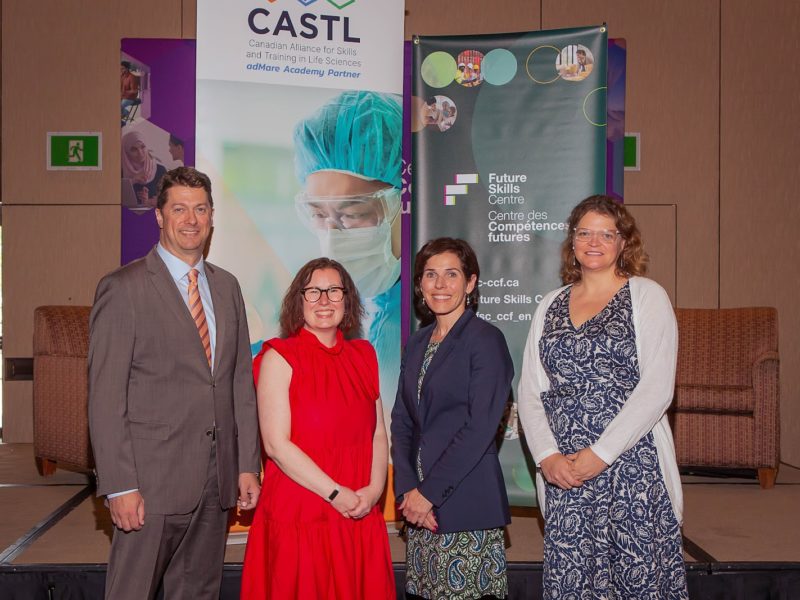
CASTL launches national biomanufacturing skills and training study in partnership with Future Skills Centre
CASTL has launched a national biomanufacturing skills and training study to gather critical labour market information and future training priorities specific to Canadian biomanufacturing.

News
BCIT receives $230k from Future Skills Centre to enhance Virtualized Experiential Learning Platform
The British Columbia Institute of Technology (BCIT) is pleased to announce that researcher Dr. Moein Manbachi of the Smart Microgrid Applied Research Team (SMART) has been awarded $230,000 in funding from Future Skills Centre. This funding will support the expansion of the Virtualized Experiential Learning Platform (VELP), developed to meet the growing demand for skilled professionals in the green energy sector.

Project
From Data to Decision: AI Training and Professional Certification
This project was a short, online certified program in artificial intelligence (AI) for professionals and leaders offered by IVADO in collaboration with the University of Montreal.

Project
ABC Skills Hub
Nearly half of Canadian adults have inadequate literacy skills, meaning they have poor reading, writing and numeracy skills that limit their ability to participate in the economy and daily life. ABC Life Literacy, an expert in adult learning, has been successfully offering adult literacy courses in person, and sought to migrate this content online to be more widely accessible to individual learners and other literacy organizations across the country.

In the Media
$5.5 Million in Funding Awarded for Skilled Trades Workforce Development as CBTU, SkillPlan, Future Skills Centre, Magnet, SRDC gather in Kelowna
Kelowna, BC – Today, the Hon. Randy Boissonnault, Minister of Employment, Workforce Development and Official Languages of Canada joined leaders from Canada’s Building Trades Unions, Provincial Building Trades Councils, and workforce development partners SkillPlan, Future Skills Centre, Magnet, and SRDC to announce $5.5 million in investments supporting apprenticeships, and national-scale recruitment, assessment, and training to help underrepresented workers find well-paid careers in the skilled trades.

Research
Tutoring in the age of COVID-19: A case study of the study buddy program
The program resulted in families feeling more comfortable and confident with online learning and school work. Students and tutors alike developed problem-solving, decision-making, interpersonal and technology skills, all of which play a role in academic success.

Research
Planning for sustainable jobs 101
This project examined what kinds of future skills and jobs will be needed, how the nature of the work is changing, what kinds of support and policies can aid businesses and workers alike, and how policymakers, educational institutions, and industry can both enable and smooth this transition. It studied three specific opportunities: zero-emission vehicles in Ontario, plant-based protein in Manitoba and Saskatchewan, and mass timber in British Columbia.

Research
Newcomer pathways to employment: Canadian Diversity Magazine special issue
We outline the important role immigration plays in economic growth and in addressing skills and labour shortages, and examine Canada’s role in developing innovative approaches to address global humanitarian crises.