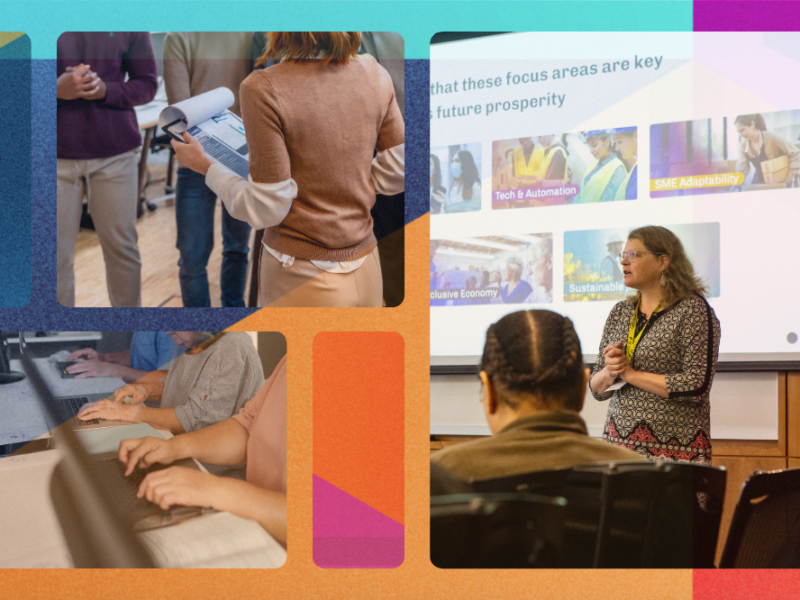
Preparing Young People for the Future of Work Means Going Beyond AI
When people talk about the future of work, the conversation almost always starts with artificial intelligence. And that’s understandable. Artificial Intelligence (AI) is transforming industries, reshaping jobs, and changing the way we work at an unprecedented pace.
But as AI becomes more deeply embedded in our workplaces, a surprising reality is emerging: the skills that will matter most are often the ones that make us distinctly human.
Human Skills Are Becoming a Competitive Advantage
At the Future Skills Centre, we think about future skills as a toolkit that blends technical expertise with social-emotional skills. Yes, digital literacy and AI fluency are important, but so are communication, collaboration, critical thinking, adaptability, and problem-solving. In fact, these human-centred skills are becoming increasingly valuable as organizations look to harness the full potential of AI.
It’s easy to assume that success in an AI-powered workplace depends primarily on technical know-how. What we’re seeing across sectors tells a different story. To use AI effectively, workers need strong written communication skills to craft prompts and interact with AI tools. They need critical thinking skills to evaluate outputs, identify inaccuracies, and make informed decisions. And they need the interpersonal skills to help teams navigate change and adopt new ways of working.
We’re also hearing a consistent message from employers across Canada: too many young people are entering the workforce without the workplace-ready skills they need to thrive. While graduates often possess strong technical knowledge, there remains a gap between what is taught in classrooms and what employers need on the job.
Experiential Learning Bridges the Gap
So how do workers, and young people specifically, build these skills?
That’s why experiential learning matters. Co-op placements, work-integrated learning opportunities, and hands-on workplace experiences give students the chance to develop both technical expertise and the communication, teamwork, and problem-solving skills that employers value most. Future Skills Centre’s ongoing research and insights show that these experiences also create clearer pathways into employment at a time when many young people are struggling to secure that critical first job.
As AI continues to reshape our economy, the future won’t belong solely to those who understand technology. It will belong to those who can combine technical knowledge with sound judgment, clear communication, collaboration, and adaptability.
The future of work may be powered by AI, but it will still be defined by people.
This article is adapted from an interview between Laura McDonough and BetaKit. AI-assisted tools were utilized for transcription and initial drafting. The final text was fully reviewed and edited for accuracy by our team.
The views, thoughts and opinions expressed here are the author’s own and do not necessarily reflect the viewpoint, official policy or position of the Future Skills Centre or any of its staff members or consortium partners.
Related Blog Posts
The 'missing work' of coordination in Canada's skills ecosystem
Building a Stronger Evidence Base for Skills: Using Linked Data to Measure Long-Term Outcomes