
Is A University Education Worth the Cost? Canadian and U.S. Perspectives

Is a university education worth the cost? Is it worth it, even if you have to borrow money to pay for it?
This question has become subject to contentious debate in the United States. In 2023, the Wall Street Journal published an article highlighting that Americans are losing faith in a university education, reflecting growing concerns about tuition, student-loan debt and uncertain labour-market returns. More recently, Pew Research reported that only 22 percent of Americans believe that a university degree is worth the cost, even if you have to take out a student loan.
Similarly, in the United Kingdom, a recent headline in The Guardian announced that a “third of people no longer believe degree is worth the time or money.” Based on the latest findings from the latest British Social Attitudes survey, the article reported that:
“the proportion of people who believe a degree is not worth the time and money has jumped from 14% in 2005 to 34% in 2025. Correspondingly, the proportion who believe those who go to university will end up a lot better off financially than those who do not has nosedived, down from 50% to 36%.”
What do Canadians think?
To find out, we decided to ask the same question that Pew Research posed in the U.S., which we did in the latest wave of the Survey on Employment and Skills. This survey is conducted by the Environics Institute for Survey Research, in partnership with the Diversity Institute at Toronto Metropolitan University and the Future Skills Centre.
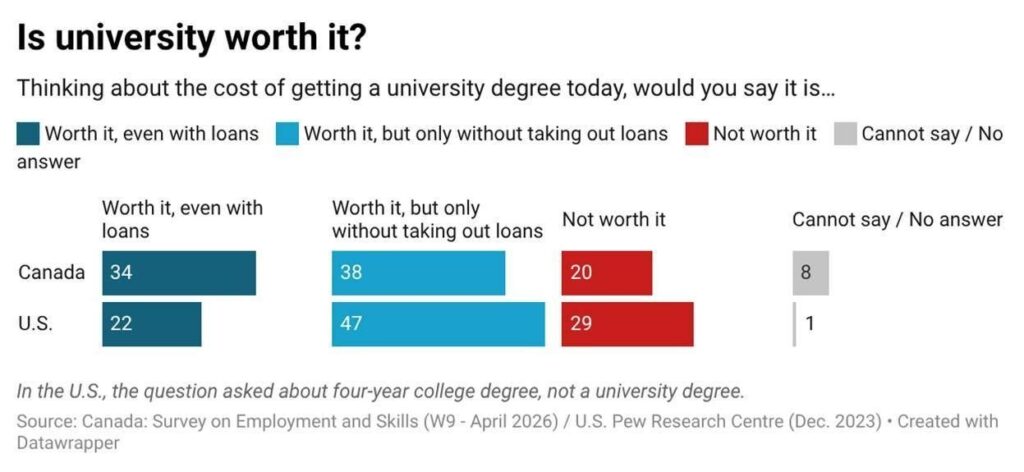
We found that Canadians are generally more likely than Americans to view a university degree as worthwhile, even with a student loan. Specifically:
- 34% of Canadians, compared to only 22% of Americas, say that a university degree is worth pursuing even if you have to take on student debt.
- Conversely, Americans (47%) are more likely than Canadians (38%) to view a degree as worthwhile only if no loans are required.
- In the United States, 29% of adults say a university degree is not worth it at all, compared to 20% in Canada.
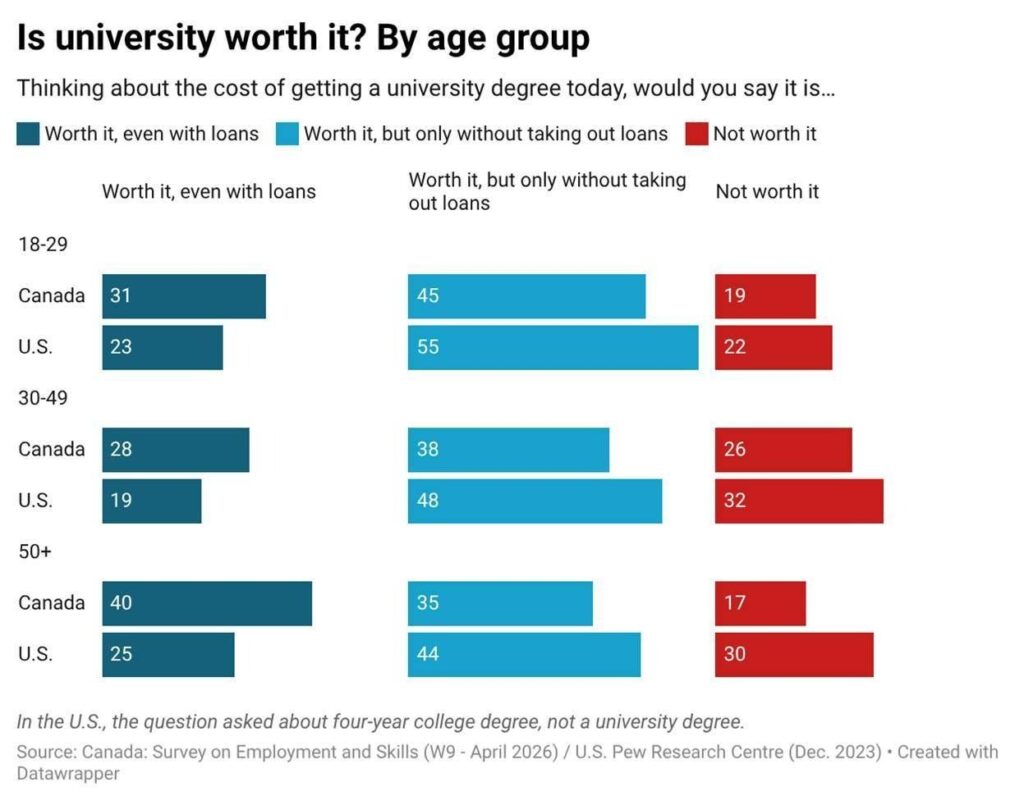
In Canada, younger people (31%) are less likely than older ones (40%) to say that a university degree is worth it, even if you have to borrow to pay for it. However, similar proportions of younger and older Canadians say that a degree isn’t worth it at all (19% and 17%, respectively). This means that younger Canadians are a little more likely to view a university degree being worth it only if a student loan is not required.
In the U.S., younger people are a little less likely than their older counterparts to say a degree is not worth it at all, regardless of whether you need a loan or not.
Interestingly, Canadians age 30 to 49 are the most likely to believe a university degree is not worth the cost under any circumstances (26%, compared to 19% of those age 18 to 29 and 17% of those age 50 and older). Canadians in this middle age group may be particularly sensitive to the issue of the returns of higher education, having experienced both tuition increases and labour market pressures during their working lives.
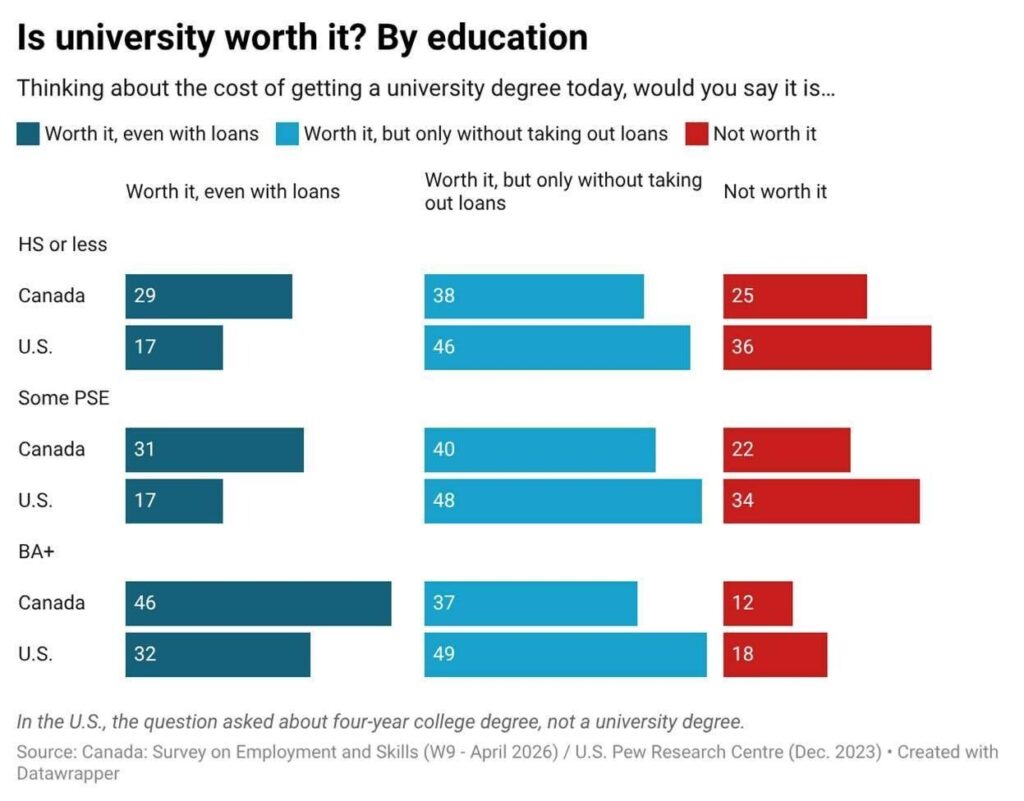
Additionally, answers vary by educational attainment. Specifically, in Canada, those with a university education are far more likely to view the cost of a university education as worth it, even with student loans (46%), compared to those with a high school education or less (29%). Only 12 percent of university graduates say a degree like the one they obtained was not worth it.
The situation is similar in the U.S., as Americans with at least a four-year college degree are much more likely than those with less education to say that college is worth the cost, even if someone has to take out loans (32% vs. 17%). It is notable, however, that a greater proportion of Canadians view the cost of a university education as worth it, even with loans, when compared to Americans – across all levels of educational attainment. The proportion of those with a high school education or less who say a degree is not worth it at all stands at 25 percent in Canada, compared to 36 percent in the U.S.
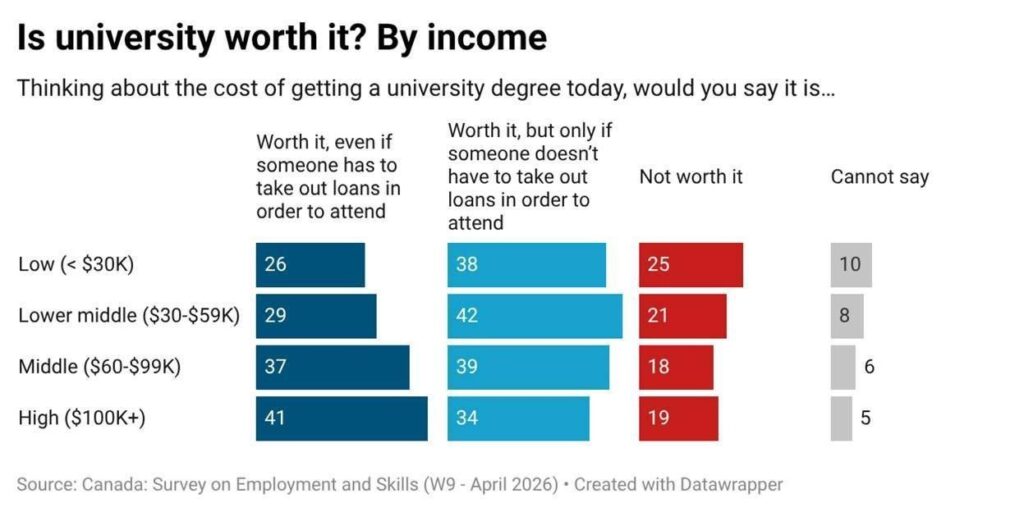
Finally, there is an income gradient in opinions about whether a university degree is worth it. Lower-income Canadians (26%) are much less likely than higher-income Canadians (41%) to say that a university degree is worth the cost, even with a student loan. These findings are particularly relevant considering recent changes to the Ontario Student Assistance Program (OSAP), which reduces the proportion of aid provided through grants and increases reliance on student loans. If perceptions of the value of a university education are sensitive to the need to borrow, such changes could influence how prospective students from lower-income households evaluate the costs and benefits of pursuing a degree.
Survey on Employment and Skills
The data in this post are from the 9thwave of the Survey on Employment and Skills. This survey is conducted by the Environics Institute for Survey Research, in partnership with the Diversity Institute at Toronto Metropolitan Universityand the Future Skills Centre. This wave of the study consists of a survey of 5,671 Canadians age 18 and over, conducted between March 24 and April 28, 2026, in all provinces and territories. It was conducted both online (in the provinces) and by telephone (in the territories). More information about the survey is available on the Environics Institute website. The authors are solely responsible for any errors of presentation or interpretation.
The Survey on Employment and Skills is funded primarily by the Government of Canada’s Future Skills Centre.
What is the Environics Institute for Survey Research? Find out by clicking here.
This blog was originally published at Canadian Survey Stuff substack.
The views, thoughts and opinions expressed here are the author’s own and do not necessarily reflect the viewpoint, official policy or position of the Future Skills Centre or any of its staff members or consortium partners.
Related Blog Posts

A Tough Job Market for Young People, and a Chance to Rethink the Path Forward

It’s Going to Take More than Doctors and Nurses to Fix our Healthcare Problems